
In-depth analysis of the Fed’s July meeting – Are internal divisions emerging ? September becomes a key window for policy shift !
- July 30, 2026
- Posted by: ACE Markets
- Category: Financial News
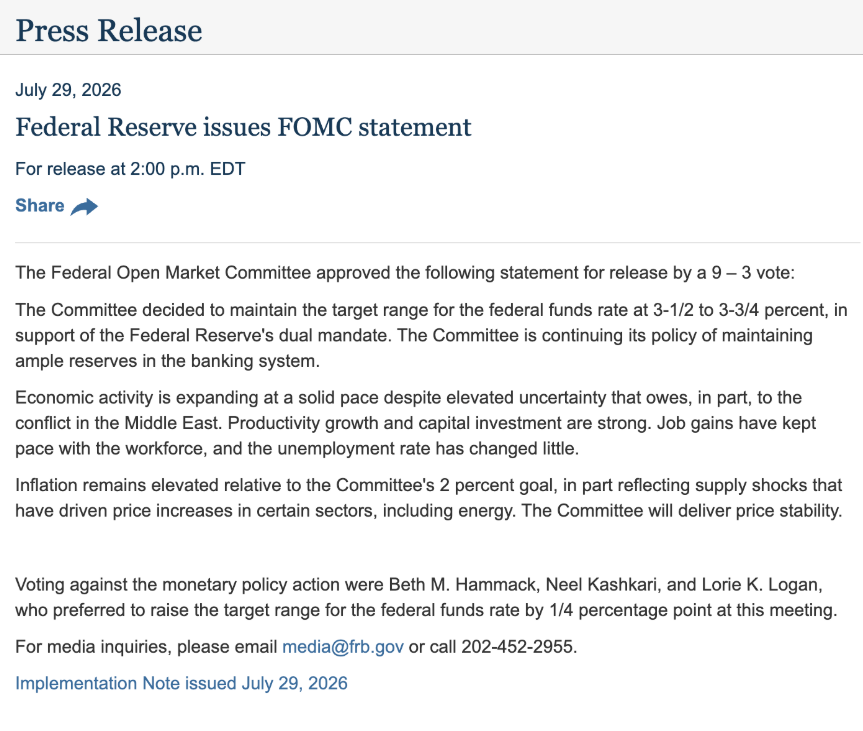
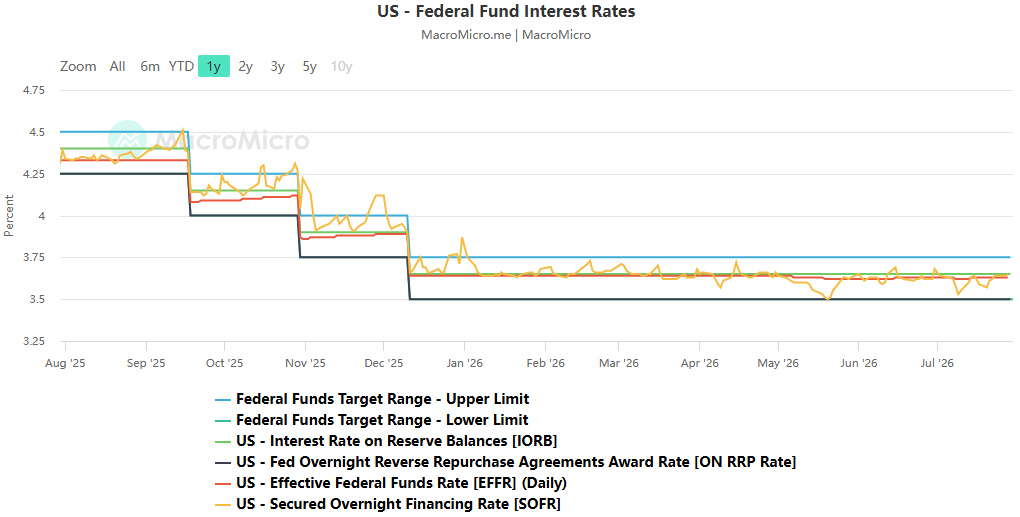
Ace Markets’ macro research team pointed out that the Fed’s decision at the July FOMC meeting to maintain the federal funds rate at 3.50%-3.75% was largely in line with market expectations. However, the internal disagreements and policy signals released at the meeting had an impact and market pricing deviation that far exceeded general expectations.
The newly elected chairman faces rare internal divisions, prompting a paradigm shift in the decision-making framework.
The meeting ultimately passed the decision to maintain interest rates by a 9-3 vote. Three officials—Cleveland Fed President Hamack, Minneapolis Fed President Kashkari, and Dallas Fed President Logan—publicly supported a 25-basis-point rate hike. This is the first time since 2016 that three officials have voted against the same policy direction.
A review of the Federal Reserve’s historical dissent by Ace Markets shows that such a scale of policy disagreement is extremely rare in the early days of a new chair’s term: since the 1970s, only Arthur Burns’ first meeting saw a similar level of dissent; Paul Volcker’s first meeting had two dissenting officials, rising to four in his second meeting; and Powell, after taking office in 2018, received unanimous support for several consecutive meetings until the first dissent appeared in June 2019. Warsh’s facing such a stark internal division in only his second meeting confirms, on the one hand, that his previously proposed “full internal debate” governing style is being implemented, and on the other hand, highlights the rapidly weakening consensus on the current policy path.
The underlying logic behind the rise of hawks: Three factors support the assessment of sticky inflation.
Ace Markets’ research team believes that the recent rise in hawkish sentiment is not a short-term emotional fluctuation, but rather an inevitable result of the convergence of multiple inflation drivers, with core support from three dimensions:
Supply-side shocks persist : Escalating geopolitical tensions in the Middle East have pushed energy prices up again, and the impact of previous tariff policies on commodity prices has not yet fully subsided, leading to continued cost pressures that have shattered previous market optimism about a one-sided decline in inflation.
Demand resilience exceeded expectations : The expansion of the artificial intelligence industry has driven rapid growth in investment in data centers and computing infrastructure, with some sectors already experiencing supply-demand gaps. Hawkish analysts believe this demand is highly sustainable and not a short-term, one-off shock; without constraints on aggregate demand, inflationary pressures are unlikely to subside naturally.
The real interest rate has been passively eased : the real policy interest rate level after adjusting for inflation has fallen significantly compared to the expectations at the beginning of the year when interest rates were cut; coupled with the stock market remaining at a high level and the overall loose corporate financing environment, the actual easing of the monetary environment has exceeded the current economic needs, which is also the core quantitative basis for the committee members to advocate tightening in advance.
In contrast, the cautious camp maintains that the job market is not the primary driver of current inflation, and that one-off shocks will eventually subside over time. They argue that raising interest rates too early could trigger policy overshooting. The essence of the disagreement lies in differing judgments regarding the “persistence of inflation” and the “policy lag.” The “0.2% monthly core inflation” threshold proposed by New York Fed President Williams is becoming a key reference for the market to observe policy shifts—if the reading remains consistently above this level, it indicates overheated demand rather than simple cost transmission, and the necessity for policy tightening will rapidly increase.
The “no guidance” strategy amplifies volatility; the September meeting will become a key verification window.
Ace Markets’ strategy team emphasizes that Warsh’s decision-making model, which emphasizes “weakening forward guidance and relying on data-driven approaches,” is amplifying the volatility of market expectations. Unlike the Fed’s previous explicit guidance on interest rate paths, the central bank is now deliberately reducing advance warnings about future policies, leaving market pricing without a stable anchor and significantly amplifying the speed and magnitude of expectation shifts. Currently, the interest rate futures market has priced in a probability of a 25 basis point rate hike at the September meeting exceeding 60%, indicating that the market is rapidly correcting its previous expectations of unilateral easing.
In our view, the FOMC meeting on September 15-16 will be a key verification window for this policy cycle: the Fed will receive two new inflation and employment data sets, sufficient to make a clearer qualitative judgment on whether current price pressures are “short-term fluctuations” or a “trend reversal,” and the policy direction will also see a substantial choice. The assessment of Kurt Lewis, a former Fed official and senior advisor at Piper Sandler, also corroborates our view: the threshold for a Fed rate hike this year is not high, and if price pressures continue to emerge in the next two months, the probability of policy implementation will increase significantly.
Behind the market anomalies: Long-term inflation expectations are being reassessed.
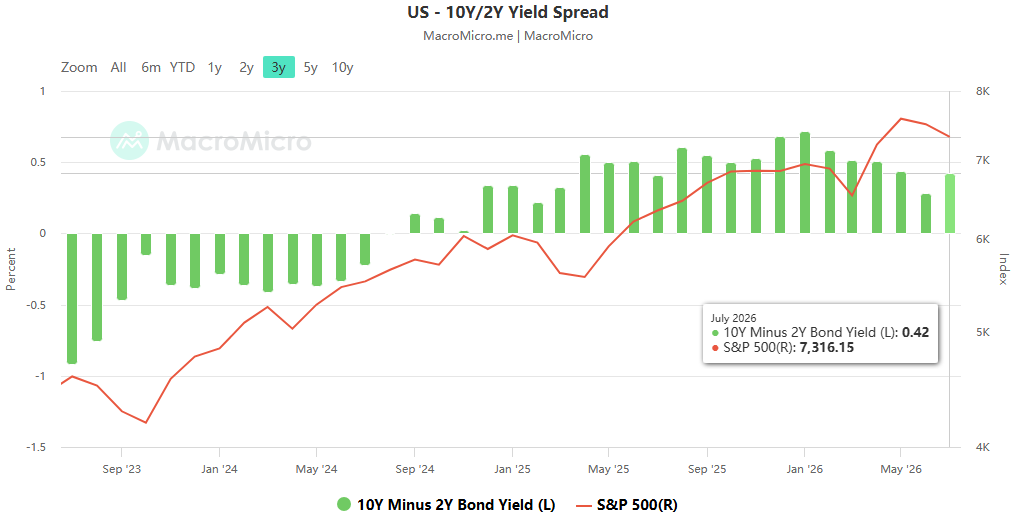
Regarding the performance of major asset classes after this meeting, Ace Markets’ fixed income team observed a highly significant maturity divergence: the 2-year Treasury yield, sensitive to policy expectations, declined somewhat due to expectations of a “delayed rate hike,” but long-term interest rates rose sharply, with the 30-year Treasury yield experiencing its largest single-day increase in over a year, reaching its highest level since 2007; equities also came under pressure, with the Dow Jones Industrial Average falling over 1,100 points in a single day, a drop of 2.2%. This trend essentially reflects the market’s reassessment of the long-term inflation center—the Fed’s short-term inaction has not dispelled investors’ concerns about sticky inflation, but rather pushed up the long-term pricing of “high interest rates lasting longer.” Meanwhile, the 30-year fixed mortgage rate has risen to 6.76%, a near one-year high, and the rising cost of financing for households is gradually being transmitted to the real economy.
Balancing Policy and Politics: The Delicate Game Between the White House and the Federal Reserve
Ace Markets’ policy research team notes that the interaction between the White House and the Federal Reserve is entering a new, delicate phase. Trump has publicly expressed his support for Warsh, stating that he “wants to see lower interest rates,” while attributing high rates to “politicized committees.” This maintains his stance on rate cuts while avoiding direct confrontation with the new chairman. However, it’s worth noting that if the Fed raises rates in September or even later this year, the policy conflict between the White House and the central bank is likely to escalate again. For Warsh, this presents a core test since taking office: if he pushes for rate hikes, he needs to prove that the decisions are entirely based on inflation data and free from political interference; if he shifts to rate cuts, he needs to explain why he is changing his previously maintained anti-inflationary stance.
Finding a balance between political pressure, market expectations, and the central bank’s credibility in combating inflation will be crucial to determining the credibility of its policies. Overall, Ace Markets believes the Federal Reserve is currently at a critical crossroads in its policy cycle, with three intertwined constraints, making a linear prediction of a policy shift extremely risky. For investors, it is essential to abandon rigid thinking about unilateral easing or tightening, closely monitor marginal changes in core inflation and employment data, and be wary of cross-asset volatility risks arising from rising long-term interest rates and fluctuating policy expectations.
 English
  Chinese
  Vietnamese
  Hindi
Hindi  Japanese
  Thai
Thai  Korean